- A man cycles a distance of
at and then walks a distance of at Find the total number of hours he spent travelling.
A.
B.
C.
D.
Answer: A.
Explanation: Total time is the sum of the time spent cycling and the time spent walking. Using the formula:
Cycling time
Walking time
Total time
2. A function is defined byFor what value of is not defined?
A.
B.
C.
D.
Answer: D.
Explanation: A rational function is not defined when the denominator is equal to zero. To find this value, set. Solving for gives:
3. A scientific sensor records air pollution levels in baseIf the highest recorded pollution level for a week was what is the decimal equivalent?
A.
B.
C.
D.
Answer: B.
Explanation: Convertto base by multiplying each digit by its positional power of :
4. In the diagramis a trapezium. and For what values of will the area of the trapezium be less than or equal to ? 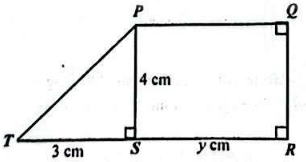
A.
B.
C.
D.
Answer: A.
Explanation: The area of a trapezium is. Here, the parallel sides are and , and the height is . Setting the inequality .
5. The diagram shows a sector of a circle of radiusIf the sector is folded to form a right circular cone, find the surface area of the cone. [Take ] 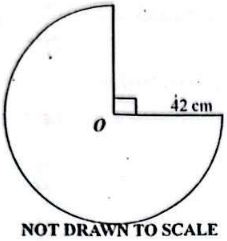
A.
B.
C.
D.
Answer: A.
Explanation: The surface area of the cone formed is equal to the area of the major sector. The angle of the major sector is.
6. In the diagram,If find the value of 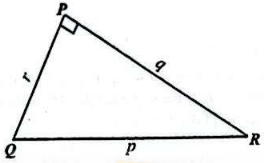
A.
B.
C.
D.
Answer: C.
Explanation: By Pythagoras theorem for the right-angled triangle, . Substituting the given relation : Thus, .
7. In the diagramand are tangents to the circle at and respectively. and Find 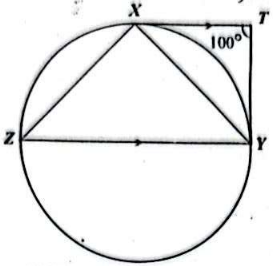
A.
B.
C.
D.
Answer: B.
Explanation: Since(tangents from a point), is isosceles. . Because , the alternate angles are equal, so . By the alternate segment theorem, . In , .
8. In the diagram,is the centre of the circle and Find 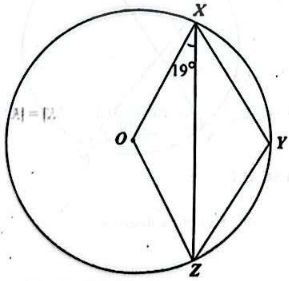
A.
B.
C.
D.
Answer: C.
Explanation: In, (radii), so . The angle at the center . The reflex angle . The angle is half this reflex angle:
9. The diagram shows a fieldwhere is a semicircle. Find the area of the field. [Take ] 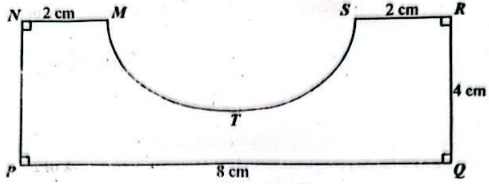
A.
B.
C.
D.
Answer: A.
Explanation: The area is the area of rectangleminus the area of semicircle . Rectangle area . The diameter of the semicircle is , so .
10. Mr. Gyan bought a car forand later sold it at of the original cost. He spent from the money he received from the sale of the car and invested the remaining at per annum simple interest. How much interest did he earn in years?
A.
B.
C.
D.
Answer: A.
Explanation: First, find the selling price of the car:After spending , the remaining amount invested is Using the simple interest formula : Rounded to two decimal places, the interest is .
11. A townis due south of town and town is on a bearing of from If town is due east of find .
A.
B.
C.
D.
Answer: B.
Explanation: The positions form a right-angled trianglewith the right angle at (since is south of and is east of ). The bearing of from implies the interior angle . Using trigonometry:
12. Ifand express in terms of and .
A.
B.
C.
D.
Answer: C.
Explanation: The volume of a cylinder is, which can be rewritten as . Substituting the expression for surface area into this formula gives:
13. The mean and range ofand are and respectively. Find the value of
A.
B.
C.
D.
Answer: A.
Explanation: The meanis the sum of the values divided by : The range is the difference between the highest and lowest values: Therefore,
14. Solve:.
A.
B.
C.
D.
Answer: A.
Explanation: Note that. The equation becomes , which simplifies to . Converting to exponential form:
15. The firstterms of an Arithmetic Progression (A.P) are and Find the value of .
A.
B.
C.
D.
Answer: A.
Explanation: In an Arithmetic Progression, the sum of terms equidistant from the beginning and the end is constant. Therefore, for the sequence, the sum is equal to the sum of the first and fourth terms:
16. Given thatand express in terms of and .
A.
B.
C.
D.
Answer: D.
Explanation: Expressas a product of its factors: . Using the laws of logarithms:
17. Find the coefficient ofin the expansion of .
A.
B.
C.
D.
Answer: C.
Explanation: Expand the expression using the distributive property:Simplify the terms: . The coefficient of is the numerical factor multiplying the term, which is .
18. A train is moving atmiles per hour. If it passes a sign post in seconds, find, in yards, the length of the train. [Take ]
A.
B.
C.
D.
Answer: B.
Explanation: First, convert the speed to yards per second. Since, . The length of the train is the distance covered in seconds:
19. A school has a total population ofstudents. Out of this number are in SHS 1, are in SHS 2 and the rest are in SHS 3. Calculate the number of students in SHS 3.
A.
B.
C.
D.
Answer: A.
Explanation: Calculate the total fraction for SHS 1 and SHS 2:The fraction of students in SHS 3 is The number of students is
20. A car consumesgallons of fuel over a distance of Find, in km per litre, the fuel consumption. [Take ]
A.
B.
C.
D.
Answer: B.
Explanation: First, convert the fuel from gallons to litres:. Fuel consumption in km per litre is the distance divided by the total litres:
WASSCE General Mathematics 2025 (Paper 1)
By Lawrence Ephrim • November 07, 2026